
Art, the brain, and the stories we carry.
A living journal from Omar Rashan—studio discoveries, cultural reflections, collector conversations, and the neuroscience behind why art can change the way a room feels.

When the artwork moves, the brain moves with it.
Texture, rhythm, memory, and color keep revealing new details long after a piece enters your home. That slow discovery can become part of everyday well-being.
Notes for the curious mind.
Open any story to read a complete short Neuro Note—with its own image, larger type, and room to breathe.
Art + Brain
When the Artwork Moves, the Brain Moves With It
Why a layered artwork keeps offering something new after the first look.
Open the note ↓
When the Artwork Moves, the Brain Moves With It
Why a layered artwork keeps offering something new after the first look.
Open the note ↓
We often think seeing happens all at once. It does not. The brain scans, compares, remembers, and returns. A shift in color can wake up a memory. A textured edge can slow the eye. A familiar rhythm can make the body feel at home before the mind has found the words.
That is why layered art keeps moving even when the canvas is still. Each return creates another encounter, shaped by the viewer’s mood, attention, and lived experience.
The artwork does not change. Your relationship with it does.
For me, Neuro Art lives in that exchange. The work is not simply placed in a room; it becomes an active part of how the room is felt.
 Studio Note
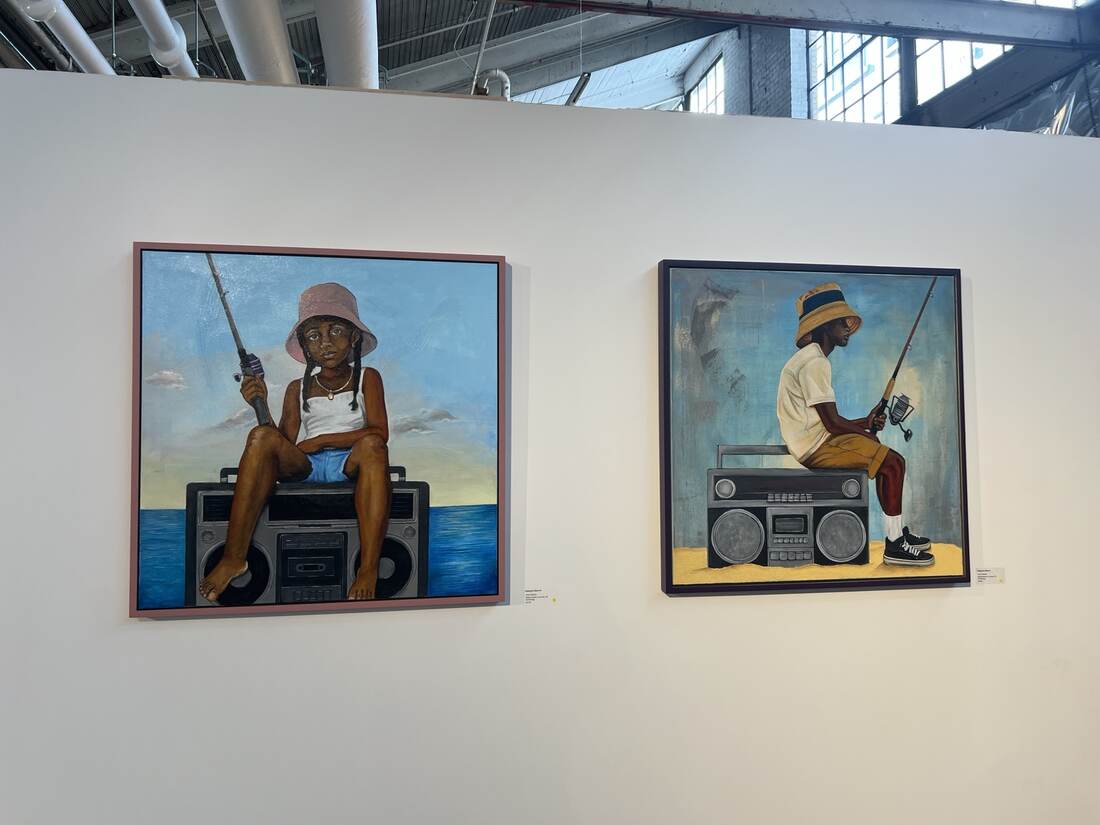
Fishing for Ideas: What Stillness Gives Back
A reflection on pause, attention, and what surfaces when we make room to listen.
Open the note ↓
Fishing for Ideas: What Stillness Gives Back
A reflection on pause, attention, and what surfaces when we make room to listen.
Open the note ↓
Fishing for Ideas began with a simple truth: not every creative breakthrough arrives through force. Sometimes an idea needs quiet water.
The children in these works are waiting, but they are not empty. Their stillness is active. The boombox holds rhythm and memory. The fishing line reaches into possibility. Together, those elements ask us to remember the kind of attention we had before everything demanded an immediate answer.
Stillness is not the absence of creation. It is often where creation gathers itself.
Both paintings were collected during BUTTER preview night. That response reminded me that people are hungry for permission to pause.
 Collector’s Lens
Living With Art That Changes the Room
The best placement becomes a daily cue for reflection, energy, and emotional reset.
Open the note ↓
Living With Art That Changes the Room
The best placement becomes a daily cue for reflection, energy, and emotional reset.
Open the note ↓
Choosing art for a room is not only a question of matching colors. It is a decision about the energy you want to meet every day.
A work near the entrance can set the emotional tone of a home. A piece across from a favorite chair can become a place for the eyes to rest. Art in a workspace can interrupt mental fatigue and return you to curiosity.
The right work does not merely complete the room. It continues the conversation.
Collectors often tell me that they notice something different depending on the light, the hour, or what they are carrying emotionally. That ongoing discovery is part of the value.
 Culture + Memory
Texture Is Memory With a Surface
On tactile storytelling and the marks that allow history to remain visible.
Open the note ↓
Texture Is Memory With a Surface
On tactile storytelling and the marks that allow history to remain visible.
Open the note ↓
Texture carries evidence. A raised mark records a decision. A scraped surface reveals what came before. A layer left visible says the history of the work matters.
My African and Asiatic influences remind me that pattern, surface, symbol, and story have never been separate languages. They work together. The hand leaves a rhythm that the eye can feel.
A smooth surface can be beautiful. A lived surface can remember.
That is why I resist polishing away every trace of process. The marks make space for human complexity—and invite the viewer to come closer.
 Video Note
A Portrait Can Hold More Than a Face
A brief look at presence, legacy, and conversation across generations.
Open the note ↓
A Portrait Can Hold More Than a Face
A brief look at presence, legacy, and conversation across generations.
Open the note ↓
A portrait is never only about resemblance. The face may be the doorway, but presence is the room.
When I painted Nikki Giovanni, I was thinking about the weight of a voice: how language can challenge, comfort, provoke, and outlive the moment in which it was spoken. The goal was not to freeze her in place. It was to let the portrait carry some of that living energy forward.
Portraiture becomes powerful when recognition turns into relationship.
The viewer brings their own memories to the encounter. In that meeting, the portrait can become a conversation between generations.
Neuro Notes will keep growing.
New studio films, collector perspectives, cultural stories, and observations from Omar’s evolving practice will continue to enter this journal.